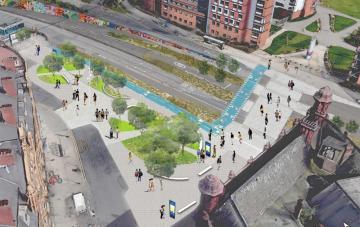
Birmingham City Council are consulting on two active travel transport schemes in the Knowledge Quarter, a ‘super crossing’ on James Watt Queensway and further active travel measures across the Knowledge Quarter. The consultation closes on 1st March 2026.
The consultation can be found here: Birmingham Knowledge Quarter Accessibility Improvements.
James Watt Queensway Super Crossing overview:
This scheme will reduce the number of traffic lanes, making it faster and easier for people to walk across the Queensway. The currently staggered crossing will be straightened out, and a parallel cycle crossing will be installed, connecting to the existing cycle track.
The underpass under Lancaster Circus was restricted to buses to reduce the motor traffic entering the city centre, and so it makes sense to reduce the number of motor traffic lanes on this stretch of the Queensway. A bus gate will be installed on the outbound side, which will help speed up buses by giving them priority over other motor traffic.
The changes will benefit public transport and active travel here, but it is disappointing that the scheme uses shared-use pavement where the cycle track meets the main pedestrian route, rather than maintaining a continuous cycle track with some form of pedestrian crossing. Cycle users and pedestrians are expected to ‘make it work’ despite the differences in direction and speed.
Overall, however, these are positive plans which we support.
Knowledge Quarter active travel plans overview:
The wider active travel plans cover Cardigan Street, Jennens Road, Woodcock Street and Lister Street. While these plans have good measures for people who are walking, they display a lack of understanding of what cycle users need.
The plans have protected cycle lanes but also cycle users sharing the road with general motor traffic, switching back and forth between the two. On Jennens Road, which is a major dual carriageway, cycle users are still expected to share the road with buses, cars, taxis and lorries, with no replacement for the pop-up cycle track that was removed. There is also a motor traffic calming chicane that will force motor vehicles into the path of cycle users, instead of providing cycle by-passes to the chicane.
Government guidelines (see Local Traffic Note 1/20, issued in July 2020) specify the motor traffic speeds and volumes where it is appropriate to ask cycle users to share the road and where cycle users need to be given segregated space. These plans do not share details of the motor traffic speeds and volumes measured on these roads, so we are unable to judge if the plans are adequate or not. Consultations are deficient if they do not provide appropriate information that respondents need to critically evaluate proposals. This is a persistent issue with the consultations released by Birmingham City Council.
Detailed comments:
Jennens Road:
The proposals include improved and new pedestrian-only crossings that will greatly benefit the walking enviroment here. The minor side-road junctions will also have continuous footway crossings built, to give clearer priority to pedestrians.
However, this major road is too busy to ask cycle users to cycle on the general carriageway, and the bus lanes are too patchy to be an acceptable alternative, so it is to be expected that many cycle users will use the pavements along this major road. The police are unlikely to tell any pavement cyclists to use the main road here because of the motor traffic conditions.
It is negligent of these plans to not make the crossings into toucan crossings, and install shared-use pavement signage on this major road. By failing to do this, the plans will exacerbate hostility towards cycle users who mitigate the risks they face by choosing to cycle on the pavement here.
Cardigan Street:
Motor traffic on Cardigan Street will be reduced through the use of bus gates and a modal filter on Belmont Row, effectively only permitting buses, taxis and bicycles to use Cardigan Street as a through-route. These measures will make Cardigan Street probably quieter than Woodcock Street and Lister Street, and definitely quieter than Jennens Road. Despite this, Cardigan Street is the only street that will have protected cycle infrastructure - the other roads will have cycle users sharing the carriageway with motor traffic.
In addition, the protected cycle lanes on Cardigan Street are poorly designed, with no protection at junctions, and disappearing at bus stops, so cycle users will have to mix with motor traffic to go around buses, and also when vehicles are turning in and out of junctions.
The plans for Cardigan Street make strategic sense - stepped cycle tracks are expensive to install, so they should be done in a way that provides a meaningful safe experience, rather than in short, patchy, stretches that will feel as if they are over as soon as they begin. The infrastructure designed for Cardigan Street does not look like it will help more people to cycle.
LTN 1/20, Sections 9.2 and 9.3 have guidance about how to assist the transitions from carriageway to cycle track and pavement, while section 6.6 has guidance on how to take cycle users past bus stops. If this national guidance had been followed, then the stepped cycle tracks would be better designed. The plans for Cardigan Street disappointingly do not show awareness of this national guidance, despite it having been released over 5 years ago.
Woodcock Street:
Woodcock Street is joined to Cardigan Street by a straightened and expanded toucan crossing over Jennens Road. The connection will work well for cycle users who are crossing from Cardigan Street to Woodcock Street, but for cycle users going in the other direction, they will need to cross three arms of this junction to simply continue going straight. Pedestrians also have a similar issue because of the lack of a crossing on the north arm of this junction, but because pavements are naturally bi-directional, they don’t have to keep swapping sides of the road in the way that cycle users do.
Once on Woodcock Street, cycle users will be instructed to join the general carriageway, even though the pavement is being widened along much of the length of Woodcock Street. Despite the numerous car parks in the immediate vicinity, the number of parking bays on Woodcock Street will be increased. If the opportunity was taken to build stepped cycle tracks along this road instead, as the kerb line is being significantly changed, then much better cycling conditions could be delivered. If cycle tracks were installed just between Aston Street and Jennens Road, then the shared-use pavements and parallel crossing between Heneage Street West and Aston Street would make more sense and feel more tied into the local cycling network. But instead, car parking is being prioritised over cycle users’ safety.
Making the situation worse, between Jennens Road and Heneage Street West, there is a central reservation on Woodcock Street, preventing anyone from passing the two bus stops. So cycle users will have to sit and wait behind stopped buses. We are worried that some cycle users will try to slip down the space between a stopped bus and the central reservation, and then get caught under the wheels of a bus as it leaves the bus stop. It would make much more sense to remove the central reservation, and redistribute that space to the pavement and stepped cycle tracks either side of the road instead.
Holt Street:
In 2025, an experimental modal filter was put on Holt Street, at the junction with Woodcock Street, to remove motor traffic that was rat-running through there. This has improved active travel conditions on Holt Street, which these plans propose to maintain by making the modal filter permanent. This is a positive step forward for cycling facilities in this area.
It seems as if the planners think that cycle users on Holt Street should cross over Woodcock Street and then continue along Holt Street, on to Heneage Street West, in order to then connect into Aston University campus. I think this because there is no other explanation for the parallel zebra crossing and the shared-use pavement sections linking Heneage Street West and Aston Street. As a link between two side streets, across a busy road that is unsuitable for cycling on, this design makes sense. What doesn’t make sense is that the designers also expect cycle users to share the general carriageway with motor traffic on Woodcock Street (see comments about Woodcock Street above) but also think that shared-use pavements are necessary here.
Lister Street:
Between Holt Street and Dartmouth Middleway, cycle users will be expected to share the road with general motor traffic. The designers seem to expect that drivers of motor vehicles will need to be slowed down, so they have planned a traffic calming chicane on a flatter stretch of Lister Street. They have also planned a new signalised crossing next to the canal bridge, as well as raised continuous footway crossings over the side-roads, improving the walking environment. There is no indication if the level of motor traffic on this road will be low enough to make shared-use cycling and driving comfortable.
The traffic calming chicane is not designed to permit cycle users to by-pass it, against the advice provided in national guidance (see LTN 1/20, section 7.6.3 and 4 for notes on chicanes). As the pavement is being widened at the location with the traffic calming chicane, cycle by-passes could be installed both sides with no impact on the overall cost of the project. The chicane design should be rejected and an alternative design chosen.
At the junction of Dartmouth Middleway, a separate scheme will install a toucan crossing across the mouth of Lister Street this spring. It is strange that these plans don’t reference those existing plans, and it is disappointing that there does not appear to be any plan to install a dropped kerb to enable cycle users to join the pavement to access the new toucan crossing.