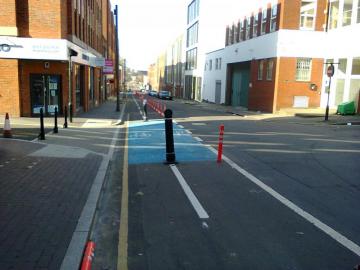
During the pandemic, Birmingham City Council introduced some pop-up cycle lanes across Birmingham that were intended to help people move around safely when public transport was impacted by measures taken to reduce the spread of Covid. Many of those pop-up cycle lanes have been retained and are gradually being made permanent. The cycle route from the city centre to Dudley Road is the latest of these upgrades, including some significant changes to the Middleway junction on the route.
The consultation details can be found on Birmingham BeHeard: City Centre to A457 Dudley Road cycle route.
The consultation closes on December 12th, 2025.
Our previous articles about the route are here:
A review of the original pop-up route.
Our response to the 2021 consultation on the route.
The 2021 consultation was supposed to lead to the route being made permanent, but the plans weren’t taken forward following that consultation. This current consultation is a clear improvement on the 2021 consultation and it seems that the responses to the previous consultation were listened to and amendments made in response.
Since the original pop-up route was constructed, the cycle track on Dudley Road, reaching down to the Middleway junction has been completed. That cycle track, however, has not yet been continued on the city centre side of the Middleway. For the moment, this pop-up route represents the main cycle infrastructure connecting the city centre to Dudley Road and the Summerfield area, despite being a considerable diversion from the obvious route down Summer Hill Road and Sand Pits. Hopefully in the future that direct route will be developed, but in the meantime this upgraded pop-up route needs to be evaluated as a major connection.
Overview of the route:
The cycle track has two main sections: from Dudley Street, crossing the Middleway and up to the top of Carver Street, it will predominately be a bi-directional cycle track with segregation from motor traffic; along Legge Lane and Graham Street, there will be a segregated contra-flow lane, while cycle users travelling towards the city centre will use the general carriageway. This
There were two key weaknesses in the original pop-up route: the crossing of the Middleway had cycle users mixing with motor traffic and was intimidating; the end of the cycle track empties cycle users onto Newhall Street, which is also an intimidating road with no protected space for cycling. The current proposals have solved the issue with the Middleway crossing, with a segregated bi-directional cycle track that will have its own light phase plus new pedestrian crossings on all arms. The challenge of Newhall Street still remains, however, which will continue to impact the attractiveness over all of the route.
Overall, we think that the proposals are useful, and definitely worth supporting. The changes suggested at the junction of Icknield Street (Middleway), Carver Street, and Hingeston Street will provide a really significant upgrade in safety for active travel.
However we are concerned that the cycling conditions on Newhall Street, as well as the section of cycling with general motor vehicles leading up to that, will put off a lot of potential users from considering this route. Although a lot has been done to reduce private motor traffic in this area, there are a lot of buses and taxis travelling through here so the roads are not yet quiet enough for comfortable sharing of the road between cycle users and motor vehicles, as acknowledged by the provision of the segregated cycle track travelling up-hill. In other places, such as Clissold Street, a bi-directional cycle track has been provided on much quieter roads, which makes the lack of segregation elsewhere seem more inexplicable.
Detailed comments:
Spring Hill Bridge to Hingeston Street:
The pop-up route branches off the main Dudley Road cycle track to run alongside the Old Line Birmingham Canal, before swinging down Clissold Street and Capstone Avenue to reach Hingeston Street. This initial section running alongside the canal is more isolated than the surrounding residential streets, so it is likely that at night many users cycling down Dudley Road will continue along the main cycle track before turning at the Tesco onto Ellen Street and continuing along there to the connection with Hingeston Street. It is still worth up-grading the pop-up route, as it provides links to major cycling routes for the residents in this area.
The new parking restrictions along Clissold Street will be important to keep the cycle track clear of parked cars. There might need to be some parking restrictions at the turning triangle at the bottom of Capstone Avenue and next to the modal filter to keep the dropped kerbs for the cycle route clear at those points too.
Hingeston Street:
The original pop-up cycle route used uni-directional cycle lanes either side of Hingeston Street, with ramps to bring the cycle lanes up to the pavement level at the bus stops. These cycle lanes filled up with leaves in autumn, but were not swept clear regularly. Dirt and mud also accumulated next to the ramps for the bus stops, with quite thick mud in places, presenting a hazard to cycle users. The new plans introduce a single bi-directional cycle track that has a bypass around the bus stop. This will reduce the potential for conflicts between bus passengers and cycle users, as well as making it easier for cycle users to join and leave the cycle track without crossing the main traffic lanes on Hingeston Street.
The bi-directional cycle track proposed here is a substantial improvement on the original pop-up cycle lane and should hopefully be easier to keep clean and free of leaves and debris.
Junction of Hingeston Street, Icknield Street (Middleway) and Carver Street:
In the original pop-up cycle route, cycle users crossed this large multi-lane junction with motor traffic, and then had to swing across Carver Street to join the cycle track. The new plans introduce a signal-controlled crossing for cycle users connecting the bi-directional cycle tracks either side, as well as 3 new signal-controlled pedestrian crossings. Separating cycle users from motor traffic on this junction will make it significantly safer and more welcoming, changing this cycle route from one that is suitable mainly for more confident cycle users to one that most people can use. This junction upgrade will contribute to greatly improving active travel links across the Middleway, improving connectivity for the local residents to the city centre.
Carver Street:
The existing bi-directional cycle track here will have a kerb installed along it, replacing the plastic wands that were initially installed. Those wands are often damaged, perhaps conveniently so, by motor traffic, with self-entitled drivers then parking on the cycle track while visiting local businesses. Although it is illegal to drive on mandatory cycle lanes, it seems that understanding of the highway code is low and the lack of double-yellow lines leads some drivers to think that they can still park there. Although a solid kerb will be less convenient for cycle users, it will present more of a barrier to those people who think parking their car is more important than the safety of cycle users.
Although it is not technically necessary, it would be better if there were also double yellow lines installed along Carver Street, to provide more clues for car drivers about where they are and are not permitted to park.
The removal of 4 parking spaces in the cycle track at the top of Carver Street will also help to clarify that parking on the cycle track in general is not permitted.
Legge Lane and Graham Street:
The main change along this section is changing the priorities at the junction with Newhall Hill, where traffic travelling up Newhall Hill will have to give way to traffic on Legge Lane and Graham Street. Cycle users travelling contra-flow down Frederick Street will have a traffic island to protect them from motor traffic from Graham Street. As Legge Lane will remain one-way for motor traffic, then all motor traffic travelling up Graham Street will need to turn right into Frederick Street, so a traffic island will be necessary to prevent them from cutting the corner and potentially hitting cycle users exiting Frederick Street.
The lack of road markings on the plans where Legge Lane and Graham Street meet is worrying because of the transition between the one-way traffic on Legge Lane to the two-way traffic on Graham Street. All motor traffic travelling up Graham Street will have to turn across cycle traffic heading to the city centre, to enter Frederick Street. In addition, there are 4 parking spaces close to the end of Legge Lane which will push cycle users into the middle of the road as they approach the cross-roads. Without clear road markings, the transition from one-way to two-way motor traffic, plus the turning actions, could lead to confusion about where cycle users will position themselves on the road as they cross this junction, putting them at risk of misjudgements by motor vehicle drivers.
It might be better to keep a give-way line at the end of Graham Street, in addition to the new give-way line on Newhall Hill, so that priority is given to traffic on Legge Lane and on the cycle track. Or the give-way line on Graham Street could be moved forward into the junction to show priority over Newhall Hill, but still give priority to Legge Lane and indicate where motor traffic should be in that junction before turning. In addition, painting ‘No entry’, as seen at the end of Vittoria Street, would provide additional visual cues that motor drivers can not proceed down Legge Lane.
The introduction of a kerb for the cycle track here will give more separation from motor traffic, although the plastic wands don’t seem to get as much damage along this stretch as on Carver Street. The shared pedestrian and cycle space at the bus stop should work ok, but care will need to be taken with the drains on the up-hill side, to avoid large puddles forming and creating a hazard in the cycle lane.